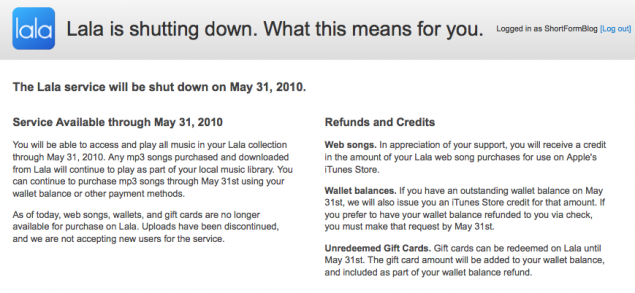
We’re currently out a song-sharing host. OK, we knew this day was coming the second that Apple bought them out, but we didn’t realize it would happen so suddenly. The company is no longer allowing new playlists or web songs to be sold. Is an iTunes equivalent of Lala coming next? We can only hope, guys. This was the only music service that got it right. Being able to sample music – in full – was a revelation. (P.S.: Does anyone have any recommendations for services that we could use for our Saturday Mixtape in the future? Lala was nice because we could stay legal AND share new music. We’ve officially lost that, as of now.)source
In their defense, it was never technically announced as a real product. Last year, the Internet went aflutter over the idea of the Microsoft Courier, which turned the tablet concept into a book which focused less on consuming media but acting more like a journal where once could save scraps of content, take notes using a stylus and turn nerds into puddles of awe. Instead, the company killed it yesterday, choosing to focus their energy on the coming-soon Windows Phone 7 Series. Hopefully its memory endures, if not the product itself. source
That being said, Jobs’ letter is incredibly two-faced, hypocritical, and very misleading. It’s clearly a marketing trick to pull the wool over the eyes of consumers, and while that’s okay (they’re in it to make money, after all), it’s our job to remove that wool from our eyes.
OSNews blogger Thom Holwerda • In a response to the Apple vs. Flash saga that has been chewing up most of the online attention today. He points out that Apple has been slow moving some of its software to the Cocoa platform (which Jobs criticized Adobe for being slow to do), Apple’s use of the H264 video codec (because it’s not really open, something Holwerda has covered at length), and the suckitude of iTunes. Despite Holwerda’s take, which has been getting a lot of attention due to the fact it’s harshly written, there’s been a debate about whether or not Jobs was actually hypocritical. Don’t think about this too hard; it’ll numb your brain. source
Steve Jobs will see you in his office, STAT. Hogan, 21, found the iPhone prototype at a bar and later sold Gizmodo the device thinking it would be reviewed. Earlier, Hogan had a friend attempt to get the phone back to Apple, but reportedly didn’t try very hard. After that, he and others working with him made the rounds among journalists, asking for money, including Wired (which broke the story). Gizmodo took the bait. And the rest is this guy’s infamy. source
Key point: It’s not getting on the iPhone due to technology reasons. Steve Jobs’ 1,657-word manifesto on Flash is a really interesting document on the nature of one of Silicon Valley’s biggest fights. We don’t think Jobs has ever been this open. We’d like to see him keep this up in the future. It really makes his points seem reasonable. Here’s a summary that’s about a fifth of the size.
First: Let’s get this out of the way
noSteve doesn’t mention the
kerfuffle between Apple and Gizmodo over the leaked iPhone
noFlash won’t be getting on the
iPhone anytime soon, so lose
those dreams now, guys
Cutting his six points to three
one Flash is a closed, proprietary standard, and Apple’s goals for the Web are to use open standards such as HTML5. And lots of sites use these already.
two Flash is another thing that has to run on a device that needs to be as lightweight as possible. This affects phone performance as well as battery life.
three Flash is a technology that’s designed for PCs, not touchscreens. Plus, Adobe has been bad about supporting our platforms in the past, and could repeat here.
Key quote from his Steveness
Flash was created during the PC era – for PCs and mice. Flash is a successful business for Adobe, and we can understand why they want to push it beyond PCs. But the mobile era is about low power devices, touch interfaces and open web standards – all areas where Flash falls short.
Steve Jobs • Sticking the dagger into the company’s technology. His main point? Flash isn’t a platform designed for mobile phones, and as he’s trying to push for the strongest app development on the platform he can, he wants to avoid putting a technology on his phones that adds one more thing to the load. But he’s clear that it’s not because of competitive reasons, like everyone thinks it is. We’re still not convinced. source
Google is going to have a problem because Google is only known for search. It is only half our business; it’s 99.9% of their business. They’ve got to find other things to do.
Yahoo CEO Carol Bartz • Talking smack to the king of the hill today. Google does tons of other stuff, though! They have e-mail (just like Yahoo), a news site (just like Yahoo), a maps app (just like Yahoo), a photo site (just like Yahoo), a social networking site (just like Yahoo) and, unlike Yahoo, a hand in the mobile sphere. And, unlike Yahoo, they don’t have the rep of getting bogged down by all of the extracurricular activities, or (more importantly) of being a place where “startups go to die,” as TechCrunch recently put it. So, while Google is in need of other revenue streams, Yahoo may not be the right company to give them crap. source