Read a little. Learn a lot. • Tightly-written news, views and stuff • Follow us on TwitterBe a Facebook FanTumble us!

16 Oct 2009 16:16

tags

Tech: The iPhone App Store’s new free app policy is a win-win for all

  • We’ve always been big supporters of the freemium model, but an upsell from within your free app is just so much easier than trying to get your users to the app store again to purchase your premium version.
  • Inedible Software co-founder Eddie Marks • On Apple’s new policy to allow in-app purchases on free apps. Why is this a big deal? Well, a few things: Software makers only have to get one app approved, as opposed to two (if they’re selling a game), it fights piracy of full apps, and it’s easier to upsell from within the app as opposed to forcing people to go to the app store again. • source

15 Oct 2009 11:26

tags

Tech: 10/GUI dares you to use your fingers instead of a mouse

  • This is really awesome. It’s a rethinking of the GUI to be something that replaces the mouse AND the complexity of the window system. It uses multitouch, but not on the screen. We’re big fans of everything except the overwraught hipster names it uses.source

15 Oct 2009 11:07

tags

Tech: Some people are happy being social-networking neophytes

  • I have close friends – and I know how to reach them. People create arguments, actual arguments or disagreements as a result of Facebook. I am like, ‘Really? It’s a computer network?’ We need to stop.
  • 28-year-old Natasha Hawkins • Describing why she doesn’t use services like Facebook and Twitter – because it creates drama. Her friends are annoyed with her because it’s harder to keep her in the loop, but she’s steadfast about her beliefs. And she’s not alone. 85 percent of people between 18 and 34 used Facebook, MySpace and Twitter in August, but that means 15 percent didn’t. They may be living under rocks. They may be stubborn. Or they may just prefer human interaction. • source

15 Oct 2009 10:58

tags

Tech: Google is a massive freaking chunk of the Internet

  • 6% of the Internet’s traffic goes through Google source

15 Oct 2009 10:53

tags

Tech: Microsoft and T-Mobile recover most users’ Sidekick data. Hooray!

  • They didn’t save everyone’s data, though. The public backlash created by Microsoft’s mishandling of Sidekick data is a least a little softer after the company announced that they saved most users data. T-Mobile has been getting the brunt of the attacks even though it largely isn’t their fault. Either way, this mess isn’t looking good for the company, which wants to be on the same page as Apple in the mobile sphere. source

14 Oct 2009 21:58

tags

Tech: Daily Poll: Is e-mail eventually going to go the way of the dodo?

  • In our always-connected world, e-mail seems like a quaint, longstanding relic of yesteryear, especially considering that 1.) It’s been around 40 years and 2.) Minus all the extra stuff added over the years, it’s largely unchanged from its roots. With Google’s upcoming Wave (which we were invited to but are bored using because we don’t have any friends) and other always-on connections, it seems like e-mail could lose its cultural impact. That’s what the Wall Street Journal argues. What do you think? Vote above.source

14 Oct 2009 21:32

tags

Tech: Barnes & Noble’s dual-screen E-Reader: Hotter than the Kindle?

Oooh. Here’s a novel approach. Take the thing that people dislike about the Kindle the most (the button-heavy interface) and make it like an iPhone. Brilliant! source
 

14 Oct 2009 10:38

tags

Tech: Digg vs. the human hand: Why the world needs an editor

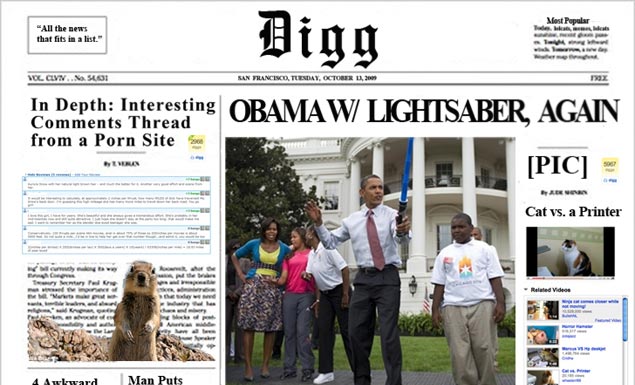
Digg as a newspaper

This image, while funny, nails what (to us) is wrong with Digg. It's not that there isn't a place for funny/bizarre content or the chance to be goofy, but when it's all you've got, it seems a little threadbare. And it's not even their fault. It's how democracy works sometimes.
  • Editors vs thumbs In a lot of ways, sites like Digg can replace rooms full of journalists and editors with a single yes/no thumb system. It works on the idea of visceral impact, much like TV news does. But when visceral impact is all you got, it stops becoming what you need to know and turns into what you want to know.
  • Editors vs thumbs In a lot of ways, sites like Digg can replace rooms full of journalists and editors with a single yes/no thumb system. It works on the idea of visceral impact, much like TV news does. But when visceral impact is all you got, it stops becoming what you need to know and turns into what you want to know.
  • Eating veggies Sometimes, the stories that aren’t very sexy are the most important. Newspapers spend hours debating these stories daily. But those stories can get overlooked in the hunt for a sexy headline. Editors have struggled with this very issue for years. Does it even come up for people clicking on thumbs?
  • Editors vs thumbs In a lot of ways, sites like Digg can replace rooms full of journalists and editors with a single yes/no thumb system. It works on the idea of visceral impact, much like TV news does. But when visceral impact is all you got, it stops becoming what you need to know and turns into what you want to know.
  • Eating veggies Sometimes, the stories that aren’t very sexy are the most important. Newspapers spend hours debating these stories daily. But those stories can get overlooked in the hunt for a sexy headline. Editors have struggled with this very issue for years. Does it even come up for people clicking on thumbs?
  • It’s not all bad We don’t want to disparage link journalism, because it can work. We’re big fans of Y! Combinator’s Hacker News, for example, because it has this strong mix of audience, community and focus. The Windy Citizen does a great job applying it to a local market. We want to see more of this.

14 Oct 2009 10:03

tags

Tech: World Wide Web creator Tim Berners-Lee: Sorry about the slashes

  • Look at all the paper and trees that could have been saved if people had not had to write or type out those slashes on paper over the years — not to mention the human labour and time spent typing those two keystrokes countless millions of times in browser address boxes.
  • Tim Berners-Lee • Admitting that the double-slashes separating the http: and the web address were really kinda useless and unnecessary for the design of the Web. He goes further to apology: “There you go, it seemed like a good idea at the time.” Apology NOT accepted. This fills us with RAGE! • source

14 Oct 2009 09:47

tags

Tech: The WikiReader: Wikipedia for people without iPhones handy

wikireader1014
  • It’s like a combination between an Amazon Kindle and a Tamagotchi. It looks neat. But so does your cell phone. At $99, where’s the market for this?source